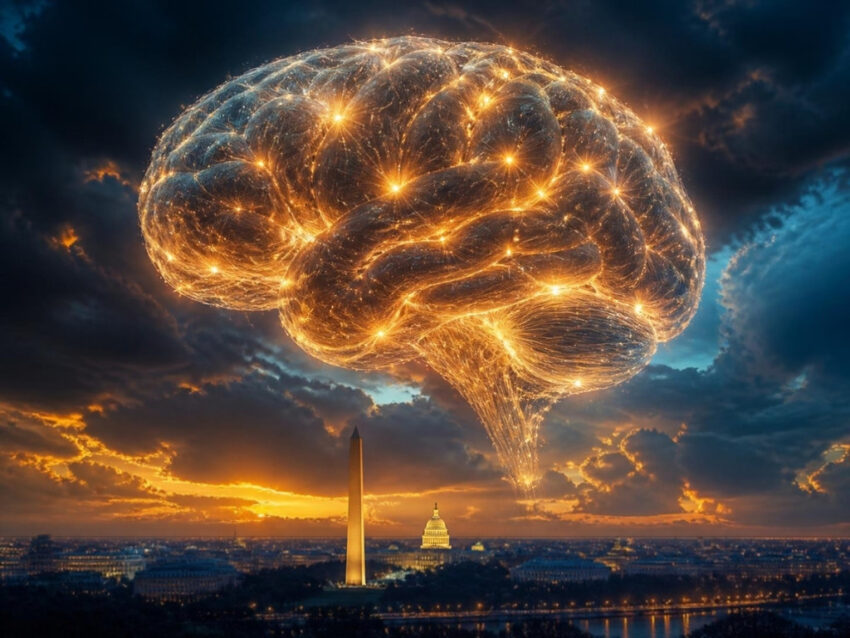
On Monday, the United States government officially stopped saying “artificial intelligence.” In its place: “superintelligence.”
The switch came through an executive order signed on September 29, 2026, titled “Inaugurating the Era of Super Intelligence.” It instructs every federal agency to replace “AI” with “super intelligence” (or “SI”) across official documents, websites, reports, and public communications.
If that sounds like pure rebranding, it mostly is. But there is more happening underneath. The same day, the CEOs of OpenAI, Google, Meta, Anthropic, Nvidia, and xAI stood with the president at the White House and signed a voluntary safety pact for frontier AI development. Here is what actually happened, what “superintelligence” means, and what it means for you.
What the executive order actually says
The order is short and specific. It directs federal agencies to use the terms “Super Intelligence” and “SI” in place of “artificial intelligence” and “AI” in official correspondence, public communications, websites, reports, policy documents, and other non-statutory materials.
A few important limits are baked in:
- It does not change any existing laws, regulations, contracts, or grants. Wherever a statute defines “artificial intelligence,” that legal definition stays exactly as it is.
- The order defines the new terms as covering the same technologies as the existing statutory definition of AI. Nothing is being reclassified, only relabeled.
- Within 60 days, the president’s science and technology adviser must submit proposed legislative language for a formal federal definition of “Super Intelligence,” in case Congress wants to adopt it.
Speaking at the launch of America.gov, a new AI-powered federal website unveiled the same day, Trump put it bluntly: “It’s not AI, it’s SI.” His argument, teased a week earlier at the United Nations General Assembly, is that the word “artificial” undersells the technology. “This is extreme intelligence,” he said. “But the word super is the best word of all and it’s the simplest.”
Why rename it at all?
Strip away the ceremony and this is a branding move, and most coverage has treated it that way. But branding from the White House carries a signal: the administration wants the government, and by extension the public, to treat this technology as a national asset to grow rather than a hazard to restrain.
Not everyone is fully on board with the vocabulary. Elon Musk, standing alongside Trump, corrected himself mid-sentence while praising the technology’s potential: “AI, SI, pardon me.” The industry itself still says AI, and there is no sign of that changing outside government walls.
For researchers, the word “superintelligence” already has a specific meaning: AI systems smarter than humans across the board, something that does not exist yet. The executive order is not claiming that milestone has been reached. It is simply giving today’s AI a grander name in official Washington.
The White House accord signed the same day
The renaming got the headlines, but the more substantive event was the “White House Accord on Superintelligence: A Joint Commitment on Frontier SI Responsibilities,” signed Tuesday by Trump and the leaders of xAI, Meta, Nvidia, Google, Anthropic, and OpenAI.
The accord is voluntary. Trump called it “morally binding” and compared it to a constitution, while conceding it carries no legal force. House Speaker Mike Johnson summarized it as “robust internal controls and layers of internal and external review.” The four commitments are:
- Robust internal controls around cybersecurity and preventing misuse of frontier models
- Internal monitoring teams dedicated to catching problems in how the technology behaves
- Independent external auditors to evaluate the companies’ safety practices
- Independent board-level committees to review the auditors’ findings and internal reports
Reactions were mixed. Meta’s Mark Zuckerberg framed it as principles and commitments around “building robust internal controls.” Anthropic’s Dario Amodei, who has been the loudest voice warning about AI risks, was more cautious: the technology has “very real risks,” he said, “and the mechanism, how we address those risks, is still under discussion.”
The accord lands against a tense backdrop. Twenty-three states are urging Congress to pass binding AI regulation, voters across the political spectrum are pushing back against data center construction in their communities, and Trump has promised to name a dedicated AI czar within days.
What this means for regular people and businesses
In the short term, almost nothing changes in daily life. You will start seeing “SI” on government websites and documents, and that is about it. ChatGPT is still ChatGPT.
For businesses, the signal matters more than the vocabulary. A White House pushing voluntary industry standards instead of regulation, while defending data center buildouts, suggests the federal posture will stay pro-growth for now. If your company sells to the government or works on federal contracts, it is worth watching how the new terminology filters into requests for proposals over the coming months.
The 60-day deadline for proposed legislative language is the thing to watch next. If Congress takes it up, “superintelligence” could move from a branding choice into actual law. Until then, it is a label.
And if all of this has you thinking about how AI actually fits into a business, the practical side has not changed at all. We have a hands-on walkthrough of how to use AI to generate business ideas, which covers the tools and prompts that are genuinely useful right now, whatever Washington decides to call them.
Frequently asked questions
Is superintelligence different from artificial intelligence?
Under the executive order, no. The order explicitly defines “Super Intelligence” as covering the same technologies as the existing legal definition of AI. In research, “superintelligence” means something else entirely, AI that outperforms humans at everything, which does not exist yet.
Does the executive order change any laws?
No. It applies only to terminology in official government communications and documents. Statutes, regulations, contracts, and grants are explicitly untouched.
What is America.gov?
A new federal website launched on September 29, 2026, described as an AI-powered one-stop shop for accessing federal services and information. It was unveiled at the same event as the renaming order.
When do agencies have to make the switch?
The order takes effect for official communications going forward. Nobody is rewriting old documents; you will simply see “SI” appear in new federal materials.
Will everyone start saying SI instead of AI?
Very unlikely. The tech industry, researchers, and the rest of the world still say AI. This is a US federal government naming convention, not a global shift. If you create content with AI tools, for example our guide to the best AI video generators for YouTube, none of the tools are changing their names.
3 thoughts on “Superintelligence Explained: What Trump’s “SI” Renaming of AI Actually Means”