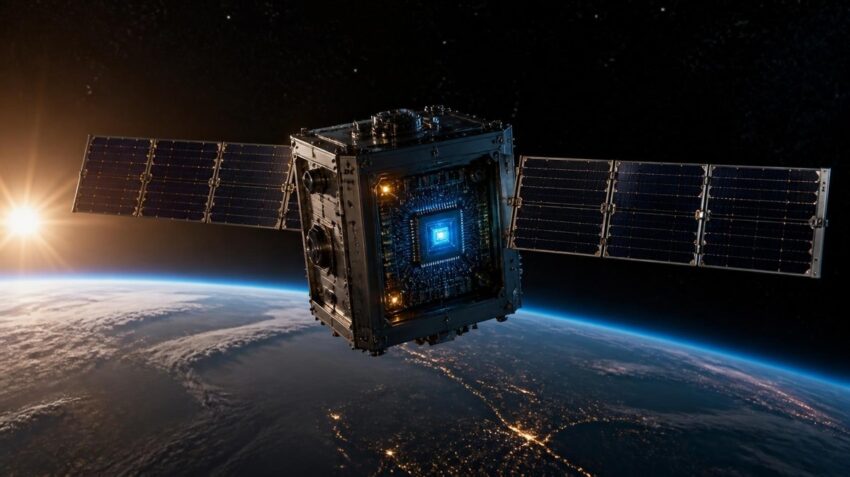
Short answer: Project Suncatcher is Google’s research project to find out whether AI data centers can one day run in space. Today, October 1, 2026, Google launches its first test satellite, nicknamed MVP, on a SpaceX Falcon 9 rocket. The refrigerator-sized spacecraft carries four of Google’s Trillium TPUs and will run Gemini AI workloads in low Earth orbit for about a year, testing whether AI chips can survive radiation, heat swings, and the vacuum of space.
It sounds like science fiction. The company that runs the biggest AI models on the planet now wants to know if it can run them hundreds of miles above it. Here is what is actually launching, why Google thinks orbit is worth a look, and the real obstacles standing between this test and a fleet of space-based data centers.
What Is Project Suncatcher?
Project Suncatcher is a moonshot from Google Research, built together with satellite company Planet Labs. The core question is simple: can AI computing hardware survive and operate in space?
Google announced the project publicly on September 24, 2026, in a post titled Behind Project Suncatcher, our moonshot to put AI in space. The company is clear that this is research, not a product. The first flight is a validation test for future hardware, and Google says the satellite itself only has to answer whether its chips power on and keep working through launch stresses, radiation, and extreme temperature swings.
The backdrop is the exploding demand for AI compute. Data centers that train and run models like Gemini are hitting real limits on Earth: electricity grids, land, water for cooling, and permits. Google is not the only one looking up. SpaceX and startups like Starcloud are exploring orbital compute too, which is exactly why the company moved its first test forward to October 2026 instead of early 2027 as originally planned.
What Is Launching on October 1
Here are the confirmed details of the MVP satellite, the first Suncatcher test flight:
- Launch date: October 1, 2026
- Rocket: SpaceX Falcon 9, on the Transporter-18 rideshare mission
- Launch site: Vandenberg Space Force Base, California
- Partner: Planet Labs, which built the satellite body
- Payload: four Google Trillium TPUs, the same chips Google uses in its ground data centers
- Compute power: roughly equal to one server in a regular data center
- Solar output: about 1 kilowatt
- Orbit: dawn-dusk, sun-synchronous low Earth orbit, so the panels see near-constant sunlight
- Planned lifetime: about one year
A TPU is Google’s custom tensor processing unit, the chip it designed specifically to run AI workloads. Four of them fit the point of this mission: this is a test of survival, not scale. The satellite will answer simple AI queries using Google’s Gemini models while Google watches for the failure modes that matter most in space.
Why Put AI Chips in Space at All?
The entire pitch comes down to one number: Google says solar panels in low Earth orbit can collect up to eight times more solar power than the same panels on the ground. There are no clouds, no nights, and no atmosphere in the way. In a dawn-dusk sun-synchronous orbit, the satellite rides the line between day and night and its panels stay in sunlight almost continuously.
That matters because AI training and inference are ravenously power-hungry, and power is now the real bottleneck for AI growth. On Earth, building a new data center means fighting for grid capacity, water permits, and land near fiber. In orbit, the sunlight is free and constant.
Google’s 2025 research paper on the topic argues that if launch prices fall below $200 per kilogram by the mid-2030s, a space data center’s costs could roughly compare with the energy costs of a terrestrial one. That is a big “if,” but it is the math the whole project rests on.
The Real Challenges: Radiation, Heat, and No Repair Tech
Suncatcher’s biggest enemies are not competitors. They are physics.
Radiation
Cosmic radiation can flip bits in memory and damage circuits over time. Google tested its Trillium TPUs in a proton beam at UC Davis’s Crocker Nuclear Laboratory while running real AI workloads, and the initial results showed the chips could survive a total radiation dose greater than a five-year space mission would deliver. But Google itself says only orbit can confirm real-world behavior. These are standard data center chips, not radiation-hardened space parts, so this test is the honest part of the experiment.
Heat
In space there is no air to carry heat away. The satellite can only dump heat by radiating it, and its radiator is limited by the small size of the spacecraft. Google’s Travis Beals told The New York Times that the prototype’s chips can run for about 15 minutes before they must shut down to cool. The MVP will operate in bursts, not continuously. That constraint reflects the prototype’s mass-limited cooling system, not a fundamental limit, but it shows how far orbital compute is from production today.
Maintenance
There is no way to send a technician to swap a failed chip. Every part of the satellite has to work for a year with zero service. If a TPU degrades or fails, that capacity is gone. This is the harshest difference between an orbital data center and one in Iowa.
What Happens After the MVP
Google has sketched out a roadmap if the MVP returns clean data:
- 2027: two more satellites to test laser interconnects between spacecraft, the networking backbone any future cluster would need
- Long term: designs for fleets of more than 80 satellites, organized in 81-module clusters
- Mid-2030s target: orbital data centers that cost about the same as data centers on the ground
Google’s senior vice president for research, James Manyika, keeps expectations grounded. He told The New York Times that Google does not expect anything usefully operational in the next few years. The MVP is a data-gathering mission: clean radiation and thermal data, then the 2027 milestone, then the economics get tested.
What This Means for You
Nothing changes for anyone using AI today. The models behind Gemini, ChatGPT, and Claude all run on Earth, and they will for years. Project Suncatcher is a research bet on where the cost of compute goes over the next decade.
But it is worth watching as a signal. When Google is willing to strap its own server chips to a competitor’s rocket to test whether orbit solves the power problem, it tells you how serious the terrestrial power crunch has become. The AI boom keeps hitting physical limits, and companies are starting to treat those limits as the real battleground. For more on where AI itself is heading, see our explainer on what superintelligence means and why the demand for compute keeps rising.
Frequently Asked Questions
When does the Google Project Suncatcher satellite launch?
The first satellite, nicknamed MVP, is scheduled to launch on October 1, 2026, aboard a SpaceX Falcon 9 on the Transporter-18 rideshare mission from Vandenberg Space Force Base in California.
How many AI chips are on the Suncatcher satellite?
Four. The satellite carries four Google Trillium TPUs, the same chips Google uses in its ground data centers, together delivering roughly the compute power of one terrestrial data center server.
Why is Google putting a data center in space?
Solar power. Google says panels in low Earth orbit receive up to eight times more solar power than on the ground, with near-constant sunlight in a dawn-dusk orbit. The project tests whether free, constant solar energy can one day offset the electricity, land, and cooling constraints of terrestrial AI data centers.
How long can the chips run in orbit?
Only in bursts. Google says the prototype’s TPUs can operate for about 15 minutes before needing to shut down so the radiators can cool, because the small satellite cannot shed heat fast enough. This reflects the prototype’s mass-constrained design, not a permanent limit.
Is Project Suncatcher a working data center?
No. Google describes the MVP as a hardware validation test. It will answer simple Gemini queries, but its real job is to collect data on radiation, thermal stress, and chip reliability. Google says nothing usefully operational will come out of the program for several years.
What comes after the first satellite?
If the MVP returns clean data, Google plans to launch two more satellites in 2027 to test laser interconnects between spacecraft, and has designs for fleets of more than 80 satellites. The company estimates orbital data centers could cost about the same as ground data centers by the mid-2030s.
1 thought on “Google Project Suncatcher Explained: AI Chips in Space, Launch Date and What Comes Next”