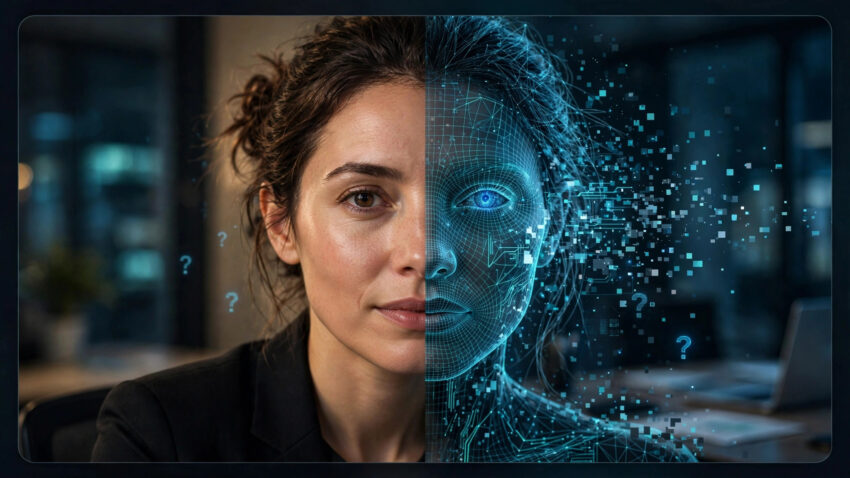
On October 1, 2026, San Francisco startup Tavus announced Griffin, a new AI model it calls the first Human Interaction Model. The company’s headline claim is bold: Griffin is the first model to pass the video Turing test. In Tavus’s own test, 48 percent of the 54 people who talked to a Griffin-powered avatar on a live video call believed they were talking to a real human. Here is what Tavus actually demonstrated, how the technology works, and what it means for hiring, customer service, and trust online.
What Tavus claims Griffin can do
Griffin is designed for real-time video conversation. Unlike a text chatbot that answers typed questions, Griffin shows up as a lifelike human avatar on a video call. It listens to speech, watches visual cues like body language, and responds with a human-like voice, facial expressions, and movement. Tavus says Griffin generates every pixel of every video frame in real time from a single reference image: not just the face, arms, and fingers, but the movement of the chair, the shadows it casts, and the background.
The avatars come in male and female looks and appear to breathe and blink naturally. According to the company, Griffin can interrupt a person, be interrupted without losing its train of thought, and adjust to a new subject mid-conversation. Tavus CEO and co-founder Hassaan Raza said the new model eliminates what he called the reality-breaking glitches of earlier AI avatars, including the problem of an avatar smiling while hearing bad news.
In demonstrations, Griffin taught a participant how to solve a Rubik’s Cube and played a game of Simon Says, reacting to visual cues as they happened. Tavus says models like this could one day work as tutors for students in schools.
How the Turing test experiment was run
The details of the experiment matter, because the claim passed the Turing test sounds bigger than what was actually measured. Participants came through an independent research platform. They were told they would be matched with another participant for a one-minute call about what they were looking forward to this year.
The partner on that call was a Griffin-powered avatar. After the call, participants wrote down the partner’s answer and rated naturalness, trust, and whether they felt listened to. Only at the very end were they asked whether it had ever crossed their mind that the partner might not be a person. Then everyone was told it was AI.
The results Tavus published: 26 out of 54 participants, or 48 percent, said they believed the partner was a real person. Those who believed it was human were 79 percent confident on average, nearly as confident as the 81 percent average among those who correctly spotted the bot. A comparison run using a conventional avatar pipeline (Phoenix 4.5 with Sparrow-2 and Raven-1) fooled just 1 of 41 participants, about 2.4 percent.
What the fine print shows
Look closer and the picture gets more nuanced. This was a short, prompted, in-house study, not a full job interview with a skeptical interviewer trying to catch the machine. Over half of the participants said the possibility of AI never crossed their mind during the call, and people who did spot the avatar usually did so within the first 20 seconds. The lowest-scoring dimension was conversation flow, rated 4.9 out of 7, below naturalness, trust, and feeling listened to.
On the technical side, Tavus points to a strong score on NVIDIA’s VideoFDB benchmark for full-duplex AI video: Griffin scored 3.83 out of 5, compared with 3.92 for the human reference video and 2.80 for the next-highest published system. That gap between Griffin and every other system is the number that has the research community paying attention, even more than the Turing test framing.
Why this matters beyond the demo
Hiring and interviews
The test was framed as a job interview, and that is where the practical questions start. AI interviewers could screen thousands of candidates consistently and cheaply, but candidates who discover they were assessed by an avatar may feel misled. Expect disclosure rules to become part of the hiring conversation, much like watermarking rules are becoming part of the AI content conversation. For more on how AI output is being labeled, see our coverage of ChatGPT’s invisible watermark.
Deepfakes and fraud
A model that convincingly passes as human on a live video call is also a model that could convincingly impersonate someone on a live video call. Scammers already use deepfake video in CEO-fraud schemes and fake job interviews. The safety question is not whether Tavus will misuse Griffin, but how the industry keeps this class of technology from being repurposed. As always-on AI agents move into customer-facing roles, the attack surface grows: see how always-on AI agents work.
Customer service and education
The benign side is real. A tutor that sees a confused expression and adjusts its explanation mid-sentence is closer to a real teacher than any text chatbot. Customer support that actually makes eye contact and notices frustration could raise the bar for automated service. The technology is dual-use, and the same capabilities that make it compelling make it risky.
What to watch next
The open questions are availability and safety. Tavus has not detailed pricing, API access, or what safeguards ship with Griffin, such as mandatory disclosure that a video call partner is AI. Those details will determine whether Griffin becomes a platform developers build on or stays a research milestone. For context on the broader race in real-time AI systems, read our explainer on Mistral’s massive Large 4 model and how AI capabilities keep shifting for small businesses at Meta Muse for small business.
Frequently asked questions
Did Tavus Griffin really pass the Turing test?
Tavus says Griffin is the first model to pass a real-time video Turing test, with 26 of 54 participants (48 percent) believing the avatar was a real human in a one-minute call. Independent researchers have not verified the result, and the test was a short, prompted, in-house study rather than a standardized exam.
What is the Turing test?
The Turing test, proposed by Alan Turing in 1950, measures whether a machine’s behavior is indistinguishable from a human’s in conversation. If a human evaluator cannot reliably tell machine from human, the machine is said to pass. Tavus applied the idea to real-time video, where voice, face, and body language all have to hold up.
How does Griffin generate video?
According to Tavus, Griffin generates every pixel of every frame in real time from a single reference image. That includes the face, arms, fingers, the movement of the chair, the shadows cast, and the background, all rendered live as the conversation happens.
When will Griffin be available?
Tavus announced Griffin on October 1, 2026, but has not publicly detailed pricing, release timing, or API availability. No enterprise or consumer rollout date has been confirmed.
What are the risks of AI avatars this realistic?
The main risks are impersonation fraud on live video calls, such as fake job interviews or CEO-fraud scams, and deception in hiring or customer service if people are not told they are talking to an AI. Disclosure requirements and detection tools are the industry’s main countermeasures.