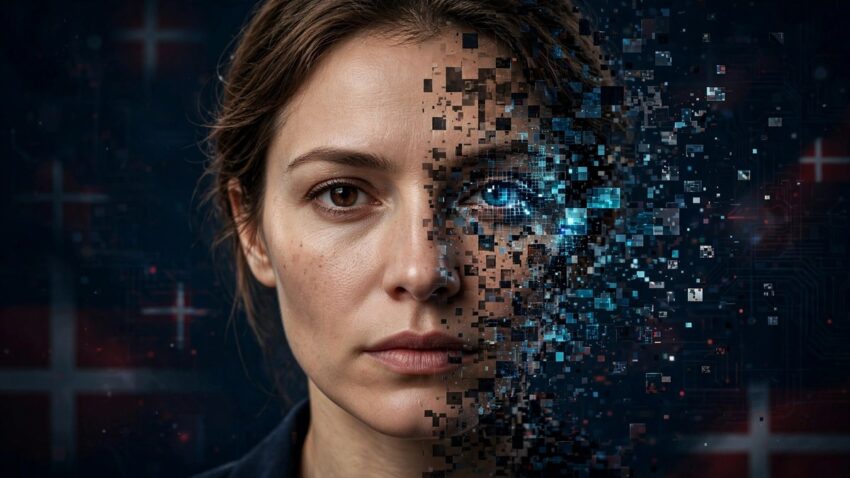
Denmark is about to do something no other country has tried: give every citizen a legal right over their own face and voice, enforced through copyright law. On October 8, 2026, Culture Minister Zenia Stampe announced she would table a bill banning the digital copying and sharing of lifelike representations of a person, including their appearance and voice, without consent. If parliament approves it, Denmark would become the first European country to build a dedicated civil right against AI deepfakes. Here is what the bill would do, what it would not do, and when it could take effect.
What Denmark announced on October 8
According to Reuters, Stampe told reporters on Thursday that she was proposing legislation to ban the digital copying and sharing of realistic representations of a person. The explicit target is AI-generated deepfakes, the synthetic videos, images and audio clips that can now be produced by anyone with a consumer-grade computer.
Two details from the announcement stand out. First, one of the bill’s main goals is to get tech giants to take down manipulated content quickly, so it causes as little harm as possible. Second, the bill is not only about ordinary citizens: it is also meant to protect artists, whose performances and work could be imitated and shared without their involvement.
Stampe was clear that the proposal is still subject to parliamentary approval. She said she hopes the bill will enter into force around the turn of the year, meaning late 2026 or early 2027. Given Denmark’s track record so far, that timeline deserves a look at the longer history of this proposal.
How the law would work in practice
The legal mechanism is the part legal experts find most interesting. Rather than creating a new criminal offence, Denmark is amending its Copyright Act. A new provision, section 73a, would make it unlawful to make realistic digitally generated imitations of a person’s physical characteristics available to the public without that person’s consent.
What that means in concrete terms:
- Consent becomes the trigger. Sharing a realistic digital imitation of someone’s face, voice or body without their permission would give them the right to demand its removal.
- Compensation without proving harm. Victims could claim compensation even without having to demonstrate reputational damage, which matters because deepfakes often spread in spaces where the victim cannot easily document the fallout.
- Protection lasts 50 years after death. The right would outlive the person imitated, modelled on the neighbouring rights already found in copyright law.
- Performers get their own provision. A second new section protects artists against realistic imitations of their performances, a direct response to AI-generated synthetic concerts and vocal clones.
- Platforms carry real liability. Social media companies would be expected to remove infringing content quickly. Officials have previously said platforms that refuse to comply could face severe fines, with disputes escalated to the European Commission.
The copyright route is deliberate. Copyright already has a mature enforcement infrastructure: notice-and-takedown procedures, platform liability rules and remedies that judges know how to apply. By placing the new right inside that framework, victims would be able to use the notice-and-action mechanism of the EU’s Digital Services Act instead of building a case from scratch every time a fake goes viral.
What would still be allowed
The bill is not a blanket ban on AI-generated imagery. It includes explicit exceptions for caricatures, parodies, satire, pastiche and work that criticises society and those in power. A political cartoon rendered by an AI image generator, or a satirical video mocking a public figure, would remain legal.
The line the government is trying to draw is between commentary and deception. Reuters’ reporting on the announcement specifically notes that work criticising society and people in power stays protected, a safeguard aimed at preventing the law from becoming a tool for silencing political speech.
Some observers have asked for the exceptions to go further. Wikimedia Denmark, for example, has argued that imitations made for predominantly informative, educational or documentary purposes should also be clearly covered, since encyclopaedias and news sites routinely use realistic AI imagery to illustrate articles about deepfakes themselves. That debate may shape the final wording in parliament.
A proposal with a long road behind it
This is not a bill that appeared overnight. The Danish government first unveiled the proposal in June 2025, with backing from parties across the political spectrum. It went to public consultation in the summer of 2025 and was notified to the European Commission under the EU’s technical-regulation procedure that autumn.
The original plan was for the law to enter into force on March 31, 2026. That date slipped when a snap general election interrupted the legislative calendar. The October 2026 announcement by Stampe is effectively the reboot: the bill is being put back on track with a new target of entering into force around the turn of the year.
The cross-party backing matters for predicting the outcome. Deepfake regulation is one of the rare tech-policy topics where political rivals largely agree, so parliamentary approval is considered likely, though amendments during the process are almost certain.
How Denmark compares to the rest of the world
Denmark’s civil-rights approach stands in contrast to what other countries have done. Italy has taken the criminal route: since 2025, spreading deceptive, harmful deepfakes has been a criminal offence there. The United States has no federal deepfake law at all, relying on a patchwork of state rules such as Tennessee’s ELVIS Act, which protects musicians’ voices, and California’s digital-replica consent laws.
The most relevant comparison for most readers is the European Union’s AI Act, whose transparency rules already require AI-generated content to be clearly labelled. OpenAI’s new textGrain watermarking system is a direct response to those rules, with a rollout in Europe driven by the AI Act’s Article 50. Denmark’s bill goes further than transparency: it does not just ask that fakes be labelled, it gives individuals a right to have non-consensual replicas removed.
The enforcement angle is where the Danish model could have the widest impact. Because the right sits inside copyright law and connects to the Digital Services Act’s notice-and-action system, a Danish citizen’s takedown request would land on platforms that operate globally. Legal experts watching the bill say it could become a template for other EU countries, which is exactly what the Danish government wants: the culture ministry has said it will push for similar protection of personal identifiers at EU level.
Why this matters beyond Denmark
Deepfake abuse is not a theoretical problem. Impersonation scams that use synthetic or stolen identities have grown into an industrial-scale fraud business. Revolut disclosed this month that scammers spent roughly five to six months impersonating officials with a real government email address to target hundreds of customers. On a larger scale, the Pentagon’s DMDC breach exposed personal details of millions of military personnel, showing how identity data, once leaked, can be weaponised in ways its owners never consented to.
Denmark’s law does not solve the criminal side of that problem. What it does is give ordinary people a fast, practical tool: see a fake of yourself, demand it comes down, and claim compensation if it does not. For a legal system confronting a technology that keeps improving, that may be the most realistic response available.
If you create content with AI tools, the practical takeaway is simple. Get consent before publishing anything that realistically depicts a real, identifiable person, and keep the consent in writing. The days when an AI-generated likeness was a legal grey area are ending, and Denmark is making sure everyone notices.
Frequently asked questions
Is the Denmark deepfake law in force yet?
No. As of October 2026 it is a proposal announced by Culture Minister Zenia Stampe. It still needs parliamentary approval, and the minister hopes it will enter into force around the turn of the year. The original version of the bill was delayed by a snap general election earlier in 2026.
Would sharing a deepfake become a crime in Denmark?
No. The proposal is deliberately civil, not criminal. It amends the Copyright Act rather than the penal code, so the remedies are takedown demands and compensation claims rather than fines or jail time. Italy, by contrast, did criminalise the spread of harmful deepfakes in 2025.
Can I still post AI memes or parody videos?
Yes. Caricatures, parodies, satire, pastiche and work that criticises society or those in power are explicitly exempt. The bill targets realistic imitations shared without consent, not comedy or political commentary.
Does the law apply to people outside Denmark?
The right itself applies in Denmark only, but its enforcement would run through platforms that operate globally. Because it connects to the EU Digital Services Act’s notice-and-action mechanism, takedown requests would reach the same moderation pipelines the major platforms use everywhere.
How long does the protection last?
The proposal grants protection for the person’s lifetime plus 50 years after death, modelled on the neighbouring rights already used in copyright law for performers and producers.