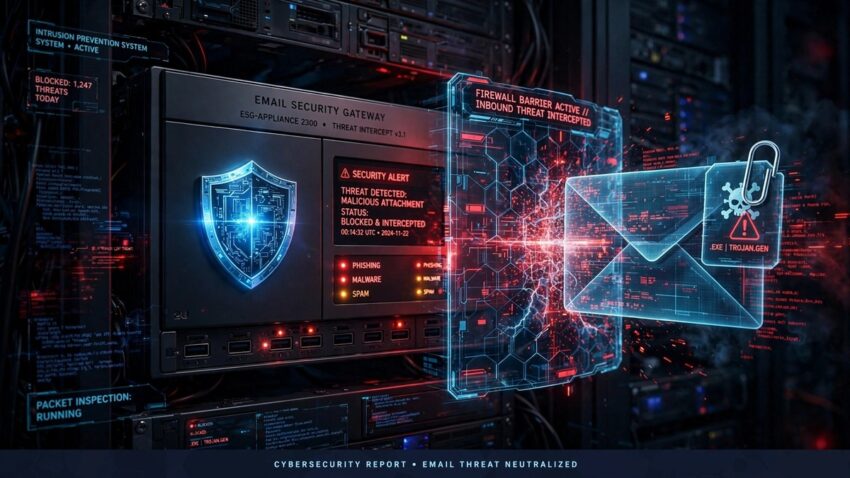
On October 14, 2026, Cisco disclosed a critical zero-day vulnerability in its Secure Email Gateway that attackers are already exploiting in the wild. Tracked as CVE-2026-76519 and rated 9.8 out of 10 on the CVSS severity scale, the flaw lets an attacker send a single crafted email attachment and potentially run commands as root on the gateway appliance, no login or user click required. Cisco’s security response team confirmed active exploitation during October.
Direct answer: If you run Cisco Secure Email Gateway with the File Reputation service enabled on a mail policy and your Content Scanner Tools package is older than 25.3.0.5525, you are exposed. Patch by upgrading AsyncOS to a fixed release (15.5.5-014 or 16.5.0-780) or by updating Content Scanner Tools to version 25.3.0.5525 or later, then check your logs for signs of earlier compromise.
What the Vulnerability Is
The bug sits in the Advanced Malware Protection (AMP) feature, specifically in how the gateway handles attachments when the File Reputation service is enabled. Cisco says the gateway fails to process certain email attachments safely, and an attacker who sends a malicious attachment through an affected device can write arbitrary files and potentially execute commands with root privileges on the underlying operating system.
Root access is the highest privilege level on a system. An attacker who reaches it effectively controls the appliance, can install persistent implants, and can tamper with or delete logs to hide the intrusion.
Why This Zero-Day Is Dangerous
Most email-based attacks need a recipient to open a file or click a link. This one does not. The exploit triggers when the gateway itself scans and processes the attachment, meaning:
- No login is required. The attacker never authenticates.
- No user interaction is required. Nobody has to open the email.
- The target is security infrastructure itself. An email gateway sits at the perimeter of corporate mail flow, often with broad network access, making it a high-value foothold.
That combination is why Cisco treated the disclosure with maximum urgency. It also mirrors a pattern seen across the vendor landscape this month. Cisco disclosed a similar flaw in the same product line back in September, its SD-WAN zero-day earlier in October, and its rival FortiMail had its own zero-day at the start of the month. Email and VPN appliances remain the most attacked class of enterprise device.
Which Systems Are Affected
Both physical and virtual Secure Email Gateway appliances are affected when they run vulnerable AsyncOS software and meet both of these conditions:
- File Reputation is enabled and assigned to a mail policy (incoming or outgoing)
- The Content Scanner Tools package is older than version 25.3.0.5525
Cisco states that the Secure Email and Web Manager and the Secure Web Appliance are not affected by this flaw.
Administrators can check whether File Reputation is enabled under the Advanced Malware Protection settings for each mail policy, and can check the installed Content Scanner Tools version with the contentscannerstatus command.
How to Patch
Cisco lists AsyncOS 15.5.5-014 and 16.5.0-780 as the fixed releases. Customers on AsyncOS 16.0 should migrate to a fixed release, and Cisco strongly recommends that installations earlier than version 16.5 move to 16.5.0-780.
Importantly, there is a lighter-weight fix path: the correction is also available as Content Scanner Tools version 25.3.0.5525 or later for licensed, supported AsyncOS releases. Installing that package does not require a full software upgrade or a restart. If automatic updates are disabled, administrators can pull it with the contentscannerupdate command and then verify the installed version.
There are no workarounds, so patching or updating the scanner package is mandatory. Customers with automatic updates enabled should confirm the fixed package actually arrived rather than assume they are protected. Good news for cloud users: Cisco says it has already deployed the corrected package across the Secure Email Cloud Gateway, so those customers do not need to take action themselves.
How to Check If You Were Already Compromised
Patching closes the door but does not tell you whether an attacker already walked through it. Cisco recommends that every customer with a potentially exposed gateway also investigate:
- Run
grep "System Security" system_logson each appliance and repeat the check on every device in the cluster. - If the result indicates a suspected compromise, begin full incident response immediately.
- If the result shows an incomplete security scan, contact Cisco Technical Assistance Center for support.
- A clean result does not prove safety. Cisco warns that attackers with root access may hide or delete evidence, so also review firewall and network logs for unexpected uploads from the gateway or downloads from suspicious addresses.
Organizations that find suspicious activity should contact Cisco TAC and preserve all available evidence. Teams that suspect a broader breach should consider that October’s Patch Tuesday and the Ivanti Connect Secure zero-day both landed in the same window, and coordinated exposure review across perimeter devices is worth the effort.
Background: Not the First Secure Email Gateway Zero-Day This Fall
This disclosure follows another actively exploited Secure Email Gateway flaw, CVE-2026-76461, reported in September. Earlier in the year, CVE-2025-20393 documented attacks against Cisco email appliances through the Spam Quarantine feature rather than AMP. The recurring theme: email security appliances are being hit repeatedly because they process untrusted content by design. Every new zero-day raises the bar on how quickly administrators must inventory and patch perimeter email systems.
FAQ
What is CVE-2026-76519?
CVE-2026-76519 is a critical zero-day vulnerability in Cisco Secure Email Gateway, disclosed October 14, 2026. Rated CVSS 9.8, it allows a remote attacker to send a crafted email attachment that the gateway mishandles, leading to arbitrary file writes and potential root command execution. Cisco confirms active exploitation.
Do I need a user to click anything for this attack to work?
No. The attack triggers when the gateway processes the attachment through its AMP File Reputation scanning. No login and no user click or file opening is required.
Am I affected if File Reputation is disabled?
No. The flaw requires File Reputation to be enabled and assigned to a mail policy, plus a Content Scanner Tools package older than 25.3.0.5525. If either condition is not met, the appliance is not vulnerable to this specific issue.
Is there a workaround if I cannot patch immediately?
Cisco states there are no workarounds. The fastest remediation is updating Content Scanner Tools to 25.3.0.5525 or later, which does not require a full AsyncOS upgrade or a restart.
Does patching remove an attacker who is already inside?
No. Patching only closes the vulnerability. If compromise occurred before the patch, the attacker may persist. Cisco recommends checking system logs with grep System Security on every cluster device, reviewing network logs, and starting incident response if compromise is suspected.
Key facts verified against Cyber Security News coverage of Cisco’s advisory published October 14, 2026 (CVE-2026-76519, CVSS 9.8, fixed AsyncOS 15.5.5-014 and 16.5.0-780, Content Scanner Tools fix 25.3.0.5525, no workarounds).
1 thought on “Cisco Secure Email Gateway Zero-Day (CVE-2026-76519): Actively Exploited Root RCE and How to Patch”