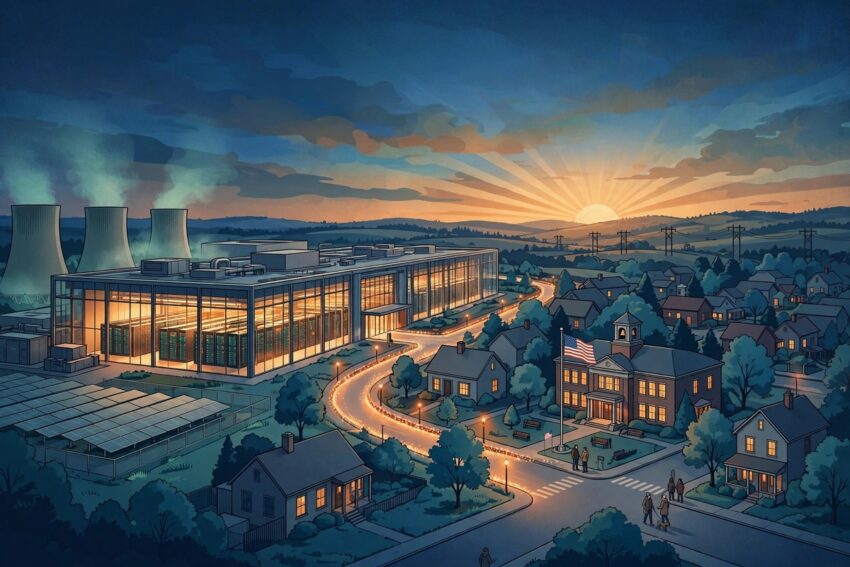
On Friday, October 2, 2026, Amazon Web Services CEO Matt Garman announced a major new initiative aimed at the communities that host Amazon’s sprawling data centers. The company is committing more than $1 billion over the next five years to U.S. towns and counties where it builds and operates data centers, through a new program called Amazon Built Together.
The short answer: Amazon Built Together is Amazon’s $1 billion, five-year investment in the communities that host its data centers. It funds free community college, skilled-trades training, and energy-efficiency upgrades for homes and schools in those towns. The announcement came alongside a broader set of promises, called the Amazon Data Center Commitment, which ends Amazon’s use of nondisclosure agreements with local governments and pledges annual public reporting of energy and water use.
What Is Amazon Built Together?
Amazon Built Together is a community investment framework aimed at the U.S. locations where Amazon operates or builds data centers. According to the announcement, the program will put more than $1 billion into those communities over five years, on top of more than $1 billion the company says it has already contributed to data center communities over the previous three years.
The program is part of a broader package Garman calls the Amazon Data Center Commitment. That commitment is organized around four principles: protecting and enhancing communities, providing jobs and economic benefit, engaging communities, and building and operating responsibly. Built Together is the funding arm of that effort, and Amazon says local communities will help decide how much of the money is spent.
What the Money Actually Goes Toward
Amazon has been unusually specific about where the $1 billion will go. The targets are concrete, which makes this more than a typical corporate press release. Here is the breakdown.
Free Community College and Skilled-Trades Training
The biggest piece is education. Amazon plans to connect more than 300,000 students to free community college degree programs over five years, covering the financial gaps left after other aid. Eligible residents can earn certificates or associate degrees in high-demand fields such as electrical work, HVAC, fiber optics, IT, healthcare, education, public safety, and advanced manufacturing, with out-of-pocket costs covered by Amazon.
Separately, Amazon is expanding its network of hands-on Modular Training Centers near its data centers. Three centers are already operating, six more are under development, and 16 additional facilities are planned. Each center offers programs lasting four to 16 weeks, and by the end of 2028 Amazon expects them to prepare up to 100,000 workers a year for local jobs, fully funded by the company.
If you live in one of these communities and want to position yourself for this training, it helps to know which certifications that get you hired fast employers actually value, so you can pair the free programs with credentials that lead directly to employment.
Energy Upgrades for Homes and Schools
The second major pillar is energy affordability. Amazon plans to fund energy-efficiency upgrades for more than 30,000 homes plus 300 schools and public buildings in data center communities. The upgrades cover items like heat pumps, insulation, and solar panels. Amazon estimates households could save roughly $700 a year on average from the improvements.
Projects Chosen Locally
Beyond education and energy, Amazon says the program will fund other locally identified priorities, including job education, water conservation, and infrastructure projects. The key detail here is that communities get a real say in how the money is spent, rather than having projects dictated from Seattle.
The Rest of the Data Center Commitment
Built Together was announced alongside several operational promises that may matter even more to residents than the funding. According to an Amazon spokesperson, the Data Center Commitment includes:
- An end to nondisclosure agreements. Amazon will no longer ask local or county government officials to sign NDAs for data center projects. Microsoft made a similar move in March 2026.
- Earlier information sharing and open houses. AWS says it will share project details earlier and hold open houses in communities to answer questions and encourage dialogue.
- Rate protection for residents. Amazon signed the U.S. Rate Payer Protection Pledge and says the rates it pays will cover the energy and infrastructure its projects require, so costs are not shifted onto other electricity customers.
- Annual public reporting. Amazon will publish yearly data on its energy use, energy efficiency, water use, water efficiency, and the share of energy from carbon-free sources.
- Local hiring and infrastructure investment. The company promises to prioritize local hiring and procurement and to invest in local grid and water infrastructure.
- Cleaner backup power. New sites will use backup generators that meet EPA Tier 4 emissions standards or equivalent regional rules.
Amazon also restated its goal of becoming water positive across its data centers by 2030, meaning it returns more water to communities than it uses. The company says it is about three quarters of the way there as of 2025, and that its data centers are seven times more water-efficient than the industry average. Its 2025 power usage effectiveness (PUE) was 1.14, which Amazon says compares favorably to the industry average of 1.25.
Why Amazon Is Doing This Now
The timing is not a coincidence. Local opposition to data center construction has been growing fast across the United States, and it is starting to threaten the pace of the AI infrastructure buildout.
Garman himself put a number on the problem: more than 100 data center moratoriums are currently being considered by local governments across the country. Grassroots campaigns have already blocked at least 45 developments across 27 states, representing about $68 billion in projects, according to figures from Environment America. Residents raise familiar concerns: water use, electricity demand, noise, traffic, land use, and whether the promised jobs ever materialize.
The announcement also landed under a political cloud. In late September 2026, Representative Jamie Raskin, the top Democrat on the House Judiciary Committee, launched an investigation into secrecy agreements between major tech companies, including Amazon, Google, Meta, and Oracle, and local officials. Ending the NDAs proactively takes one line of criticism off the table.
The business stakes explain the urgency. Amazon now expects roughly $220 billion in capital spending in 2026, much of it tied to data centers and AI chips, and the demand for AI hardware keeps climbing with each new generation of NVIDIA’s latest AI chips. Garman framed the expansion as the largest infrastructure push since the interstate highway system, and warned that if local moratoriums are enacted, the U.S. could be writing its own losing ticket to this race, and the consequences would last generations.
The pressure is so intense that some companies are looking far beyond terrestrial options for computing capacity. Google, for example, is already testing AI chips in space as a way around the land, power, and cooling constraints that come with building data centers on the ground.
What It Means If You Live Near a Data Center
If your town or county hosts, or is slated to host, an Amazon data center, Built Together is aimed directly at you. The program is starting in the United States only, and enrollment and application processes are being set up with local partners in the coming months. Amazon has said communities will be involved in deciding how funds are allocated, so keep an eye on announcements from your local government about open houses and application windows.
On the practical side, three things are worth watching: whether the free community college and training programs launch in your area and which fields they cover, whether the promised energy upgrades reach homes and schools near you, and whether Amazon follows through on the transparency pledges, particularly the annual energy and water reporting and the end of NDAs in local negotiations.
The Open Questions
A healthy dose of skepticism is appropriate. One billion dollars over five years sounds large, but it equals roughly half of one percent of Amazon’s projected $220 billion in capital spending this year alone. It is a small price for keeping the much larger construction program on schedule.
Also worth noting: the NDA pledge applies going forward. Past agreements, many of which expire once projects become public, are left untouched. And while Amazon has promised annual public reporting on energy and water use, it has not yet spelled out the format, the level of detail, or whether figures will be reported per site. Those details will determine whether the transparency pledge has real teeth.
Still, by the standards of corporate community commitments, Built Together is unusually specific: 300,000 students, 100,000 workers a year, 30,000 homes, 300 schools. Those are measurable targets, and residents now have a public scorecard to hold Amazon to.
Frequently Asked Questions
What is Amazon Built Together?
Amazon Built Together is Amazon’s $1 billion, five-year community investment program for U.S. towns and counties that host its data centers. It funds free community college, skilled-trades training, energy-efficiency upgrades for homes and schools, and other locally chosen projects.
When did Amazon announce Built Together?
AWS CEO Matt Garman announced the program on Friday, October 2, 2026, through a LinkedIn post, as part of the broader Amazon Data Center Commitment.
How much is Amazon actually investing?
More than $1 billion over five years through Built Together, on top of more than $1 billion Amazon says it has already given to data center communities over the previous three years.
Who qualifies for the free training and college programs?
Residents of U.S. communities where Amazon operates or builds data centers. Amazon says it is partnering with local community colleges and that enrollment processes are being set up with local partners in the coming months.
Is Amazon still using NDAs with local governments?
Not for new projects. Amazon says it no longer uses nondisclosure agreements with the government agencies it works with on data center projects. Microsoft made a similar move in March 2026.
Will my electricity bill go up if a data center is built nearby?
Amazon says no. It has signed the U.S. Rate Payer Protection Pledge and committed that the rates it pays will cover the energy and infrastructure its projects require, so those costs are not shifted to other customers.
Is Built Together available outside the United States?
No. Amazon has described Built Together as a U.S. program. Global availability of the broader community framework has not been announced.