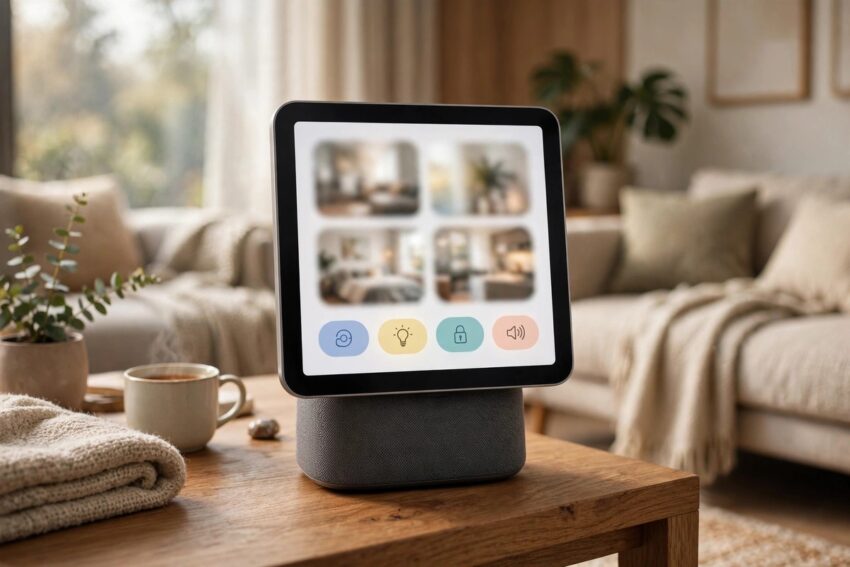
The short version: Apple has announced HomeView, its first dedicated smart home hub, priced at $299 in the US. Pre-orders opened on October 13, 2026, and the device starts shipping on November 13. It centers on a 7-inch square touchscreen with a brand new conversational Siri AI, and it comes in two versions: a tabletop model with a built-in speaker base, and a wall-mountable version. Apple also announced the HomePod mini 2 ($149, arriving October 30) and a fourth-generation Apple TV 4K.
This is the launch many Apple watchers have been waiting years for. The company has never sold a dedicated smart home display before, leaving Amazon’s Echo Show and Google’s Nest Hub to own that corner of the counter and the wall. HomeView changes that, and the headline feature is not the hardware: it is the rebuilt Siri, which Apple says is far more capable and conversational than the assistant on your phone today.
Readers who followed the rumor cycle may want to compare notes with our what to expect preview from earlier this week. Most of the big rumors held up, though the price came in lower than expected and the display turned out slightly bigger.
Apple HomeView price, pre-order and release date
Apple HomeView costs $299 in the US. That pricing applies to both the tabletop and wall-mount versions of the hub itself. Pre-orders opened the same day as the announcement, October 13, with first deliveries and retail availability on November 13, 2026.
The wall-mount version needs mounting hardware, and Apple is not making it alone. Schneider Home sells wall mounts in three configurations at $59, $79 and $129, depending on the setup. Apple has not yet announced international pricing, but given the November 13 date is the global availability date, more regions should be confirmed closer to launch.
The price is notable for two reasons. First, it undercuts the rumored ~$350 price that circulated before the event. Second, it puts HomeView in the same neighborhood as the larger Echo Show models and the Nest Hub Max, which signals that Apple intends to compete on features and intelligence rather than undercutting on price.
Design: two versions, a 7-inch display and four colors
HomeView is built around a 7-inch Liquid Retina touchscreen in a square format. It is bigger than the 6-inch display the rumors predicted, and square makes sense for a device that doubles as a photo frame and a camera viewer.
There are two distinct hardware versions:
- Tabletop version: the display sits on a built-in speaker base, a design that deliberately echoes the iMac G4’s floating-screen look. Available in silver, starlight, rose pink and space gray.
- Wall-mountable version: a slimmer unit designed to mount on the wall, available in silver and space gray.
The tabletop model’s integrated speaker means it can double as a music speaker, and it also plays a role in Apple’s Intercom system for talking between rooms and between HomeView units.
The new Siri AI is the real story
Hardware is only half the pitch. HomeView ships with a new version of Siri that Apple describes as far more capable and conversational than the current assistant. This is the Siri AI overhaul Apple has been building toward, and the smart home hub is its first dedicated home.
The details that matter:
- It can hold natural, multi-turn conversations instead of one-shot commands.
- When paired with an Apple Intelligence-enabled iPhone or iPad, it can act across apps and draw on personal context from Calendar, Messages and more.
- It is meant to answer follow-up questions, handle complex requests and keep track of what you were talking about, which is the part current smart speakers consistently fail at.
That last point is where Apple clearly thinks it can beat Amazon and Google. The Echo Show and Nest Hub have had screens for years, but their assistants still behave like command line interfaces with voices. If the new Siri genuinely handles conversation, HomeView could leapfrog them in a single generation. The catch, as always with Siri promises, is that it needs to be tested in real kitchens, not keynote demos.
Face recognition, FaceTime and smart home controls
HomeView is designed for a whole household, not one person. It supports face recognition for up to six household members, with personalized home screens, widgets and apps for each person. A guest mode hides personal information when visitors are around, and Apple says personal content stays private, while shared albums and music remain available to everyone including guests.
On the communication side, HomeView supports FaceTime with Center Stage, so the camera keeps you framed as you move around the kitchen, and Intercom for voice messages between units and household members.
For the actual smart home, the hub supports both Matter and Thread, the two standards that matter most in 2026. That means it can control devices from a wide range of brands, not just Apple’s own ecosystem, and it arrives alongside the LG smart home devices Apple co-developed, including a video doorbell, smart deadbolt lock, thermostat, temperature sensor and indoor and outdoor cameras.
Other standout features:
- Up to nine live camera feeds viewable at once, useful for the multi-camera households Apple is clearly targeting.
- Glanceable watch-style faces, including a Photos face, a Flow face that responds to movement, a Home Modular face and a Home Camera face, so the display looks intentional when idle instead of just showing a clock.
- A recipe feature that converts web recipes into step-by-step instructions with hands-free timers, which is exactly the kind of kitchen scenario this device is built for.
HomePod mini 2: $149, launching October 30
Alongside the hub, Apple announced the HomePod mini 2 at $149 in the US, up from the original’s $99 launch price and the current model’s $129. Pre-orders opened today, and it launches October 30, 2026.
The key upgrades:
- S10 chip with real-time computational audio, improving dynamic range, loudness and acoustic performance.
- Sound Glow: the top surface now animates in sync with music, pulling colors from the album artwork. Ambient soundscapes like rain trigger their own animations.
- New colors: pink, green, blue, white and midnight.
- Four-speaker surround sound when paired with the new Apple TV 4K (4th gen): the speakers and the Apple TV recognize their positions in the room and calibrate timing and levels.
One important caveat: the new Siri AI arrives via a future software update, not at launch. The mini 2 will still get voice recognition for up to six users when paired with an Apple Intelligence device, and it keeps its role as a home hub for smart home devices, with Sound Recognition for smoke and CO alarm alerts. It also works as a speaker for the Mac.
Apple TV 4K (4th generation): what we actually know
Apple confirmed that a fourth-generation Apple TV 4K is coming, announced at the same event. Beyond its existence and its role in the four-speaker surround setup with HomePod mini 2 units, Apple has not shared verified chip or pricing details yet. We will update this section as the company confirms more, and we are not repeating the unconfirmed spec lists circulating elsewhere.
HomeView vs Echo Show vs Nest Hub
The obvious comparison is with Amazon’s Echo Show and Google’s Nest Hub, which have owned this category for years. On paper, HomeView’s advantages are the new conversational Siri, deep integration with the iPhone and Apple services, and Matter and Thread support that keeps it brand-agnostic. Amazon and Google’s edge is maturity: years of routines, third-party skills and integrations, and lower entry prices.
The $299 price says Apple is not trying to win on price. The bet is that a genuinely smarter assistant plus tight Apple ecosystem integration is worth the premium. That is a bet Siri has lost before, which is why independent reviews after the November 13 launch will matter more than the keynote.
Rumors vs reality: what the preview got right
Comparing today’s announcements with our earlier rumor roundup, the hit rate was high. The square display, the iMac G4-style tabletop design, the October 13 announcement date and the new Siri AI all checked out. The misses were pleasant ones: the price came in at $299 instead of the rumored ~$350, and the display is 7 inches rather than the rumored 6 inches.
Should you pre-order the Apple HomeView?
If you are deep in the Apple ecosystem and have been waiting for a smart display, the $299 price and November 13 ship date make this an easy pre-order to consider. The Siri AI is the big unknown, and it is also the whole point of the device, so buyers who want certainty may prefer to wait for real-world reviews in November. For everyone else, the HomePod mini 2 at $149 is the lower-risk way to try Apple’s new audio and smart home push, with the Siri AI upgrade arriving later by software update.
Frequently asked questions
How much does the Apple HomeView cost?
The Apple HomeView costs $299 in the US. Pre-orders opened October 13, 2026, and availability begins November 13, 2026. Wall mounts from Schneider Home cost $59, $79 or $129 depending on the configuration.
When is the Apple HomeView release date?
November 13, 2026. Pre-orders are open now through Apple’s usual channels.
What is the Apple HomeView?
HomeView is Apple’s first dedicated smart home hub: a 7-inch touchscreen display, available as a tabletop unit with a speaker base or a wall-mountable version. It runs a new conversational Siri AI, supports Matter and Thread smart home devices, recognizes up to six household members, handles FaceTime calls with Center Stage, and can show up to nine live camera feeds.
How much is the HomePod mini 2 and when does it come out?
The HomePod mini 2 costs $149 in the US, with pre-orders open now and a launch date of October 30, 2026. It adds an S10 chip, Sound Glow animations, new colors and four-speaker surround pairing with the new Apple TV 4K. The new Siri AI comes later via software update.
Does HomeView work with non-Apple smart home devices?
Yes. HomeView supports Matter and Thread, the cross-brand smart home standards, so it can control devices from many manufacturers, including the LG co-developed lineup of doorbells, locks, thermostats and cameras.