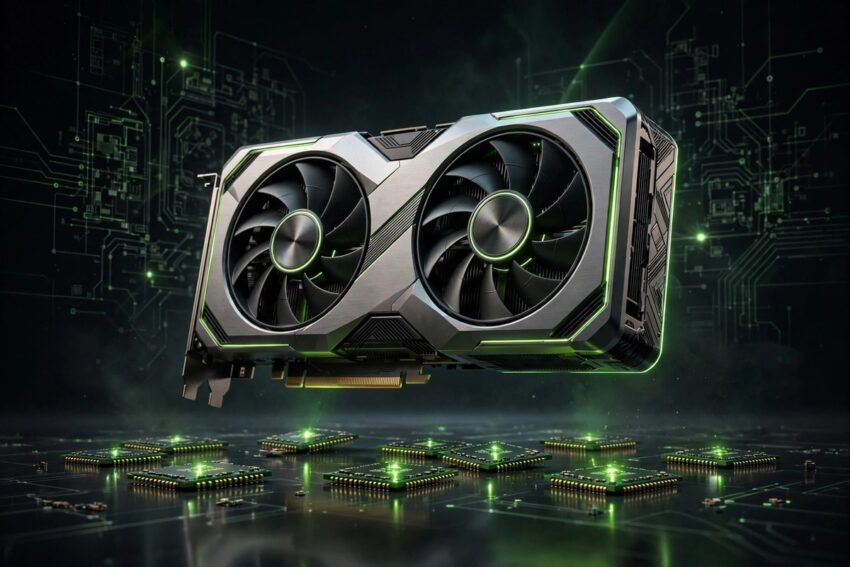
NVIDIA may break with years of tradition on its next graphics card generation. A September 22, 2026 report from hardware outlet GameGPU claims the RTX 6080 could become the first RTX 60-series card to reach store shelves, arriving ahead of the flagship RTX 6090 rather than trailing it the way second-tier cards normally do. The reason has nothing to do with silicon readiness and everything to do with memory: a severe GDDR7 supply shortage is reportedly forcing NVIDIA to rethink which card it can actually build at scale. Nothing here is confirmed by NVIDIA, but the sourcing comes from multiple outlets, and the underlying memory crunch is very real.
The rumor that broke NVIDIA’s usual playbook
NVIDIA has traditionally launched its flagship first. The top-end card grabs the headlines, justifies the premium pricing, and the rest of the lineup fills in over the following months. GameGPU’s September 22 report, written in Russian and translated across the hardware press, says the RTX 6080 “may become NVIDIA’s first next-generation graphics card instead of the RTX 6090.” To be precise, that wording refers to launch sequencing, not hierarchy. The RTX 6090 remains positioned as the flagship of the RTX 60-series stack in every version of this reporting.
German outlet AD HOC NEWS has published independent reporting on the same generation, identifying the RTX 6080 as built around a GR203 die on TSMC’s 3-nanometer process, with base and boost clocks estimated around 2,300MHz and 2,800MHz by analysts. A second AD HOC NEWS report from April 2026 described the RTX 6090 directly as the “flagship” model powered by the GR202 chip. So the disagreement in the press is not about which card sits on top. It is about which card NVIDIA can physically ship first, and the thread connecting every version of the story is memory, not compute.
Why the RTX 6080 could ship first: the GDDR7 problem
GDDR7 is the high-speed memory standard NVIDIA has used since the RTX 50-series launch, and demand has outpaced what Micron, Samsung, and SK hynix can produce. GameGPU’s supply-chain sourcing claims that 2GB GDDR7 modules have reached roughly $15 apiece in some batches, a sharp jump that makes loading a flagship card with 32GB or 48GB of memory dramatically more expensive than it was a year ago. This is not an isolated claim tied to one rumor. Micron discontinued its 2GB GDDR7 modules earlier in 2026, already squeezing supply for the current RTX 50-series, and Micron’s leadership has said memory supply is roughly 75 percent sold out heading into 2027, well before NVIDIA’s next-gen cards would hit production lines.
The root cause analysts keep pointing to is AI datacenter demand. Training and inference clusters consume enormous quantities of high-bandwidth memory, and memory makers have been prioritizing those higher-margin AI contracts over consumer GPU memory allocations. This is the same dynamic driving programs like Amazon’s billion-dollar datacenter expansion, and it puts NVIDIA in an unusual position: competing with its own enterprise and hyperscaler customers for the same constrained memory supply, while consumer gaming GPUs are not even its highest-margin product line. Rubin-era engineering resources are split between GeForce cards and far more lucrative enterprise AI silicon, a tension that NVIDIA’s own RTX Spark push has already made visible.
There is a practical logic to why a memory shortage would push NVIDIA toward launching a lower-VRAM card first. A 16GB or 20GB card consumes meaningfully less GDDR7 per unit than a 32GB flagship. With the same pool of memory chips, NVIDIA could build and ship far more RTX 6080 units than RTX 6090 units, getting a next-generation product into the market and generating revenue while the 6090’s larger memory footprint waits for supply to loosen. That reading is consistent with the reporting, though neither outlet has framed it quite that directly.
Rumored RTX 6080 vs RTX 6090 specs compared
None of the specifications below are confirmed by NVIDIA. They reflect the current state of GameGPU, AD HOC NEWS, and aggregator sourcing as of early October 2026, and they are likely to keep shifting before any official announcement:
- GPU die: GR203 for the RTX 6080; GR202 (up to 192 streaming multiprocessors) for the RTX 6090
- Process: TSMC 3nm for both, per analyst estimates, a real shrink from Blackwell’s 4N process
- RTX 6080 memory: 16GB or 20GB of GDDR7 on a 320-bit bus; GameGPU’s sourcing describes a possible cut from an earlier expected 24GB, while AD HOC NEWS lists 20GB
- RTX 6090 memory: 32GB of GDDR7 on a 512-bit bus, down from an earlier rumored 48GB
- RTX 6080 bandwidth: roughly 1.20 TB/s, per analyst calculations
- RTX 6080 clocks: around 2,300MHz base and 2,800MHz boost, labeled as estimates
- Rumored pricing: roughly $1,699 for the RTX 6080 and $2,999 for the RTX 6090, explicitly labeled as unofficial estimates
There is one wrinkle worth watching. GameGPU reported on September 21, 2026 that 4GB and 6GB GDDR7 chips are in development, and their arrival could rethink the entire video buffer configuration. With 6GB modules, the RTX 6090 could theoretically reach 48GB on the same 512-bit bus using eight chips, while the RTX 6080 could carry 24GB or even 36GB with higher-density modules. Fewer physical chips also simplifies signal routing and lowers PCB temperatures. The catch is cost: high-density chips will be expensive at first, and final configurations will only be confirmed closer to engineering validation.
When the RTX 60-series could actually launch
Reported launch windows have moved around considerably, which is itself a signal of how unsettled NVIDIA’s planning still is. Earlier GameGPU reporting placed the first RTX 60-series cards in the first half of 2027, following a late-2026 announcement window. More recent aggregated reporting pushes that window to the second half of 2027, with some reports floating a possible slip into 2028 if memory shortages tied to AI hardware demand keep worsening. That spread, from early 2027 to a possible 2028 delay, underscores that NVIDIA has not locked in a release date, and every outlet covering this story is working from supply-chain leaks rather than an NVIDIA roadmap. Treat all of this as a directional signal, not a release calendar.
What this means if you are buying a GPU right now
Practically, nothing about current RTX 50-series pricing or availability changes because of this rumor. The RTX 6080 and RTX 6090, under even the most optimistic reported timeline, are a year or more away from retail. But the GDDR7 shortage driving this story is already affecting today’s market: current RTX 50-series cards have seen their own supply disruptions tied to Micron’s memory decisions, so anyone expecting a quick price drop ahead of a 60-series launch should treat the memory crunch as a reason prices may stay elevated longer than usual, not shorter. If you are planning a build, this is also a good moment to think about the rest of your setup, since a faster GPU pairs best with a monitor that can keep up; our guide to gaming monitors for competitive play covers what to look for.
Frequently asked questions
Is the RTX 6080 replacing the RTX 6090 as NVIDIA’s flagship?
No. GameGPU’s September 22, 2026 report describes the RTX 6080 as a possible candidate to launch first, not to replace the RTX 6090 as the top-tier card. AD HOC NEWS’s reporting continues to describe the RTX 6090 as the flagship.
Why would NVIDIA launch the RTX 6080 before the RTX 6090?
GameGPU’s sourcing ties the possible reshuffle to a GDDR7 memory shortage. A lower-VRAM card like the RTX 6080 requires less memory per unit than the RTX 6090, so it could reach production and retail faster while supply is constrained. Micron’s CEO has said memory supply is roughly 75 percent sold out heading into 2027.
How much VRAM will the RTX 6080 and RTX 6090 have?
Rumors conflict. GameGPU’s sourcing suggests the RTX 6080 could drop to 16GB of GDDR7 from an earlier rumored 24GB, while AD HOC NEWS lists 20GB. The RTX 6090 is rumored at 32GB, down from an earlier 48GB figure. In-development 6GB GDDR7 chips could eventually raise those numbers.
What architecture will the RTX 60-series use?
Both cards are tied to NVIDIA’s Rubin architecture, the generation after Blackwell, which powers the current RTX 50-series. Rubin also underpins NVIDIA’s enterprise AI silicon, which is part of why memory allocation for consumer cards is under pressure.
When will the RTX 6080 and RTX 6090 actually launch?
Estimates vary widely. Earlier GameGPU reporting suggested a late-2026 announcement with cards in the first half of 2027. More recent aggregated reporting pushes that to the second half of 2027, with some reports floating a possible slip into 2028.
How much will the RTX 6080 and RTX 6090 cost?
GameGPU has floated unofficial estimates of roughly $1,699 for the RTX 6080 and $2,999 for the RTX 6090. These figures are explicitly labeled as unconfirmed, and NVIDIA has not commented on pricing.